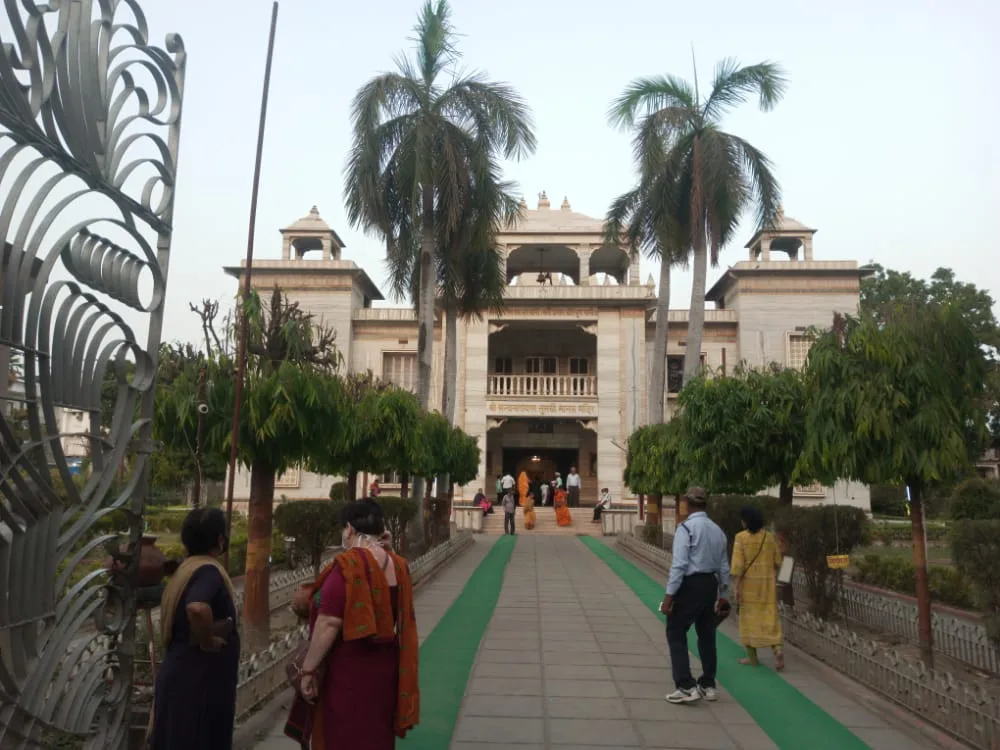
Tulsi Manas Temple Varanasi: The Ramcharitmanas Temple in Marble
The Ramcharitmanas inscribed in marble — a living text from walls to floors
Tulsi Manas Temple is one of Varanasi's most accessible and unique religious sites — a white marble temple built in 1964 on the site associated with Goswami Tulsidas's composition of the Ramcharitmanas. Unlike most ancient Varanasi temples, this is a modern, spacious, and welcoming space with no restrictions on non-Hindu visitors. The entire text of the Ramcharitmanas is inscribed in the red sandstone panels lining the walls — transforming the temple itself into a scripture.
The Ramcharitmanas in Stone
The defining feature of Tulsi Manas Temple is the inscription of the complete Ramcharitmanas on the marble and sandstone walls. The Ramcharitmanas — Tulsidas's 16th-century Awadhi retelling of the Ramayana — consists of seven Kandas (books) containing approximately 12,800 chaupai verses. Visiting this temple and reading even a portion of the inscribed text places you in the midst of one of India's greatest literary and devotional works.
For literate visitors who read Devanagari script, the temple is a remarkable experience — you are surrounded by the complete Ramayana at arm's length. For those who cannot read the script, the visual impact of walls covered entirely in dense, ornate calligraphic text remains powerful.
The Mechanical Dioramas
A distinctive feature of Tulsi Manas Temple is the set of mechanical dioramas (automata) depicting scenes from the Ramayana. Located in glass cases around the temple complex, these mechanically animated scenes — Sita's swayamvara, Ram's exile, the battle of Lanka, Hanuman bringing the Sanjeevani herb — move and play devotional music when coin-operated.
These dioramas were a popular innovation of 1960s–70s Indian temple design and have a charmingly earnest quality today. For children, they are an engaging introduction to the epic's narrative. The combination of the ancient story, the marble inscription, and the animated mechanical figures creates a uniquely multi-sensory presentation of the Ramayana.
Frequently Asked Questions
Is Tulsi Manas Temple the site where Tulsidas wrote the Ramcharitmanas?▼
The temple is built on a site traditionally associated with Tulsidas's time in Varanasi, and local tradition connects it to his writing. Scholars debate the exact location where the Ramcharitmanas was composed — some traditions place it at Tulsi Ghat or other locations in Varanasi. The temple is a devotional commemoration rather than a definitively verified historical site.
Is Tulsi Manas Temple suitable for children?▼
Yes — it is one of Varanasi's most family-friendly temples. The mechanical dioramas depicting Ramayana scenes are particularly engaging for children. The temple is clean, spacious, and non-restrictive, making it a comfortable visit for families of all backgrounds.