Dashashwamedh Ghat: Varanasi's Most Sacred Riverfront
The spiritual heart of Varanasi — home of the legendary Ganga Aarti
Dashashwamedh Ghat is the beating heart of Varanasi's sacred riverfront. More pilgrims have stepped onto these stone steps than almost any other ghat in the city, drawn by the evening Ganga Aarti fire ceremony, the proximity to Kashi Vishwanath Temple, and a spiritual atmosphere that feels unchanged across centuries. Whether you arrive by boat at sunrise or stand among thousands as the aarti lamps blaze at dusk, Dashashwamedh delivers the full intensity of Kashi.
History and the Mythology of Ten Sacrifices
The name Dashashwamedh breaks into 'dasha' (ten) and 'ashwamedha' (horse sacrifice). According to the Kashi Mahatmya section of the Skanda Purana, Lord Brahma performed ten ashwamedha yagnas (horse sacrifices) at this site to welcome Lord Shiva back to Kashi after a period of absence. An alternative tradition attributes the ten sacrifices to Emperor Divodasa, who ruled Varanasi in antiquity.
The ghat appears in some of India's oldest texts, including the Matsya Purana and the Agni Purana, which describe it as among the most sacred bathing sites on the Ganga. The present stone ghat structure was built in 1748 under the patronage of a minister of the Maratha Peshwa Balaji Baji Rao. Before that, it existed as a natural bank. Rani Ahilya Bai Holkar of Indore, who also rebuilt the Kashi Vishwanath Temple, is credited with further renovations in the late 18th century.
The Ganga Aarti: What Happens and When
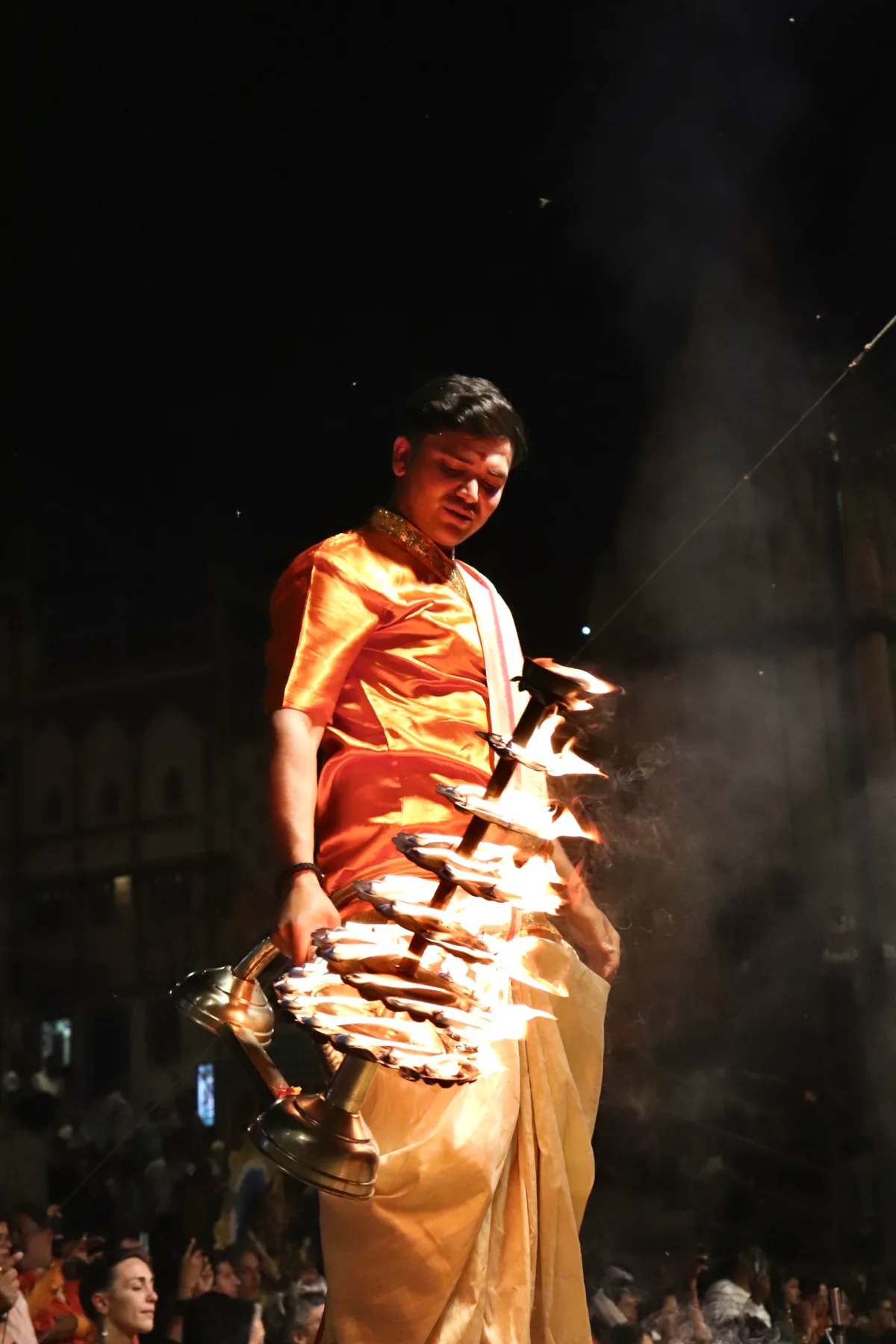
Every evening without interruption, seven brahmin priests simultaneously perform the Ganga Aarti at Dashashwamedh — a 45-minute fire ceremony using massive brass lamps (each weighing several kilograms), incense, conch shells, flowers, yak-tail whisks, and devotional music. The ceremony is fully synchronized: each priest performs the same movements in the same sequence, creating a visually overwhelming spectacle as the lamps trace arcs of light against the darkening sky.
The ceremony begins approximately 30–45 minutes after sunset. In winter (October–February) this is around 6:00–6:30 PM; in summer (April–June) around 7:00–7:30 PM. A smaller morning aarti (Subah-e-Banaras) is also performed at sunrise, usually around 5:30–6:00 AM, and is quieter and more intimate.
The best way to watch the evening Aarti is from a boat on the river, which gives an unobstructed view as the light plays across the water. Watching from the ghat steps is also spectacular but the crowd is dense — arrive at least 45 minutes early to secure a good position.
The Daytime Ghat Experience
Away from the evening crowds, Dashashwamedh is a living museum of religious life. Brahmin pandits sit under handwoven reed umbrellas at the water's edge, performing personalized puja rituals for pilgrims — reciting mantras, applying tilak, distributing prasad. Sadhus in saffron or ash-white robes meditate on the upper steps. Pilgrims from across India touch the Ganga water and carry it home in small containers.
Boat rides depart from the lower steps throughout the day. A one-hour boat ride along the riverfront — passing all the main ghats — costs roughly ₹500–1,500 per boat (negotiate before boarding). For the sunrise tour, boats typically go as far south as Assi Ghat.
The lanes immediately behind the ghat wind toward the Kashi Vishwanath Temple (5 minutes' walk), the Vishwanath Gali silk market, and the dense, ancient streets of old Varanasi. These lanes are worth exploring both before the Aarti and after — the smell of incense, the sound of bells, and the chaos of sellers, pilgrims, and sacred cows is unlike anywhere else.
Getting There and Practical Navigation
Dashashwamedh Ghat is in the heart of old Varanasi, near the Godaulia crossing — the closest major intersection accessible by auto-rickshaw or taxi. From Godaulia, the ghat is a 5-minute walk through increasingly narrow lanes.
For the evening Aarti, most hotels within the old city offer 'Aarti packages' with boat transfers. This is highly recommended for first visits, as navigating the dense crowds at night in an unfamiliar city is challenging. If arriving independently, auto-rickshaws to Godaulia are available from most parts of the city.
Parkig for private vehicles is not available near the ghat — the lanes are too narrow. All vehicles stop at Godaulia. The last stretch must be walked.
Frequently Asked Questions
Is watching the Ganga Aarti at Dashashwamedh free?▼
Yes, watching from the ghat steps is completely free. There is no ticket or entry fee. If you want to watch from a boat on the river, you pay the boatman's fare — typically ₹500–1,500 per boat for an hour, negotiated directly.
Do I need a guide to attend the Ganga Aarti?▼
No — you can attend independently by arriving 30–45 minutes before sunset and finding a spot on the steps. A guide is useful for context (explaining the ceremony's significance, history of the ghat) and for navigating the lanes confidently, but is not required.
How crowded does Dashashwamedh Ghat get during the Aarti?▼
Very crowded on any evening, extremely dense during festivals. On a typical weekday evening, expect hundreds of people; on festival nights like Dev Deepawali or Mahashivratri, expect tens of thousands. For festivals, a boat view is strongly recommended over the ghat steps.
Can I take photos during the Ganga Aarti?▼
Photography is permitted during the Aarti. Avoid using flash as it disturbs the ceremony. Use a high-ISO setting on your camera. For the best results, a boat position 20–30 metres from shore gives an unobstructed view of all seven priests simultaneously.