Bharat Mata Temple Varanasi: The Temple of Mother India
The only temple in India where the deity is the nation itself — inaugurated by Mahatma Gandhi in 1936
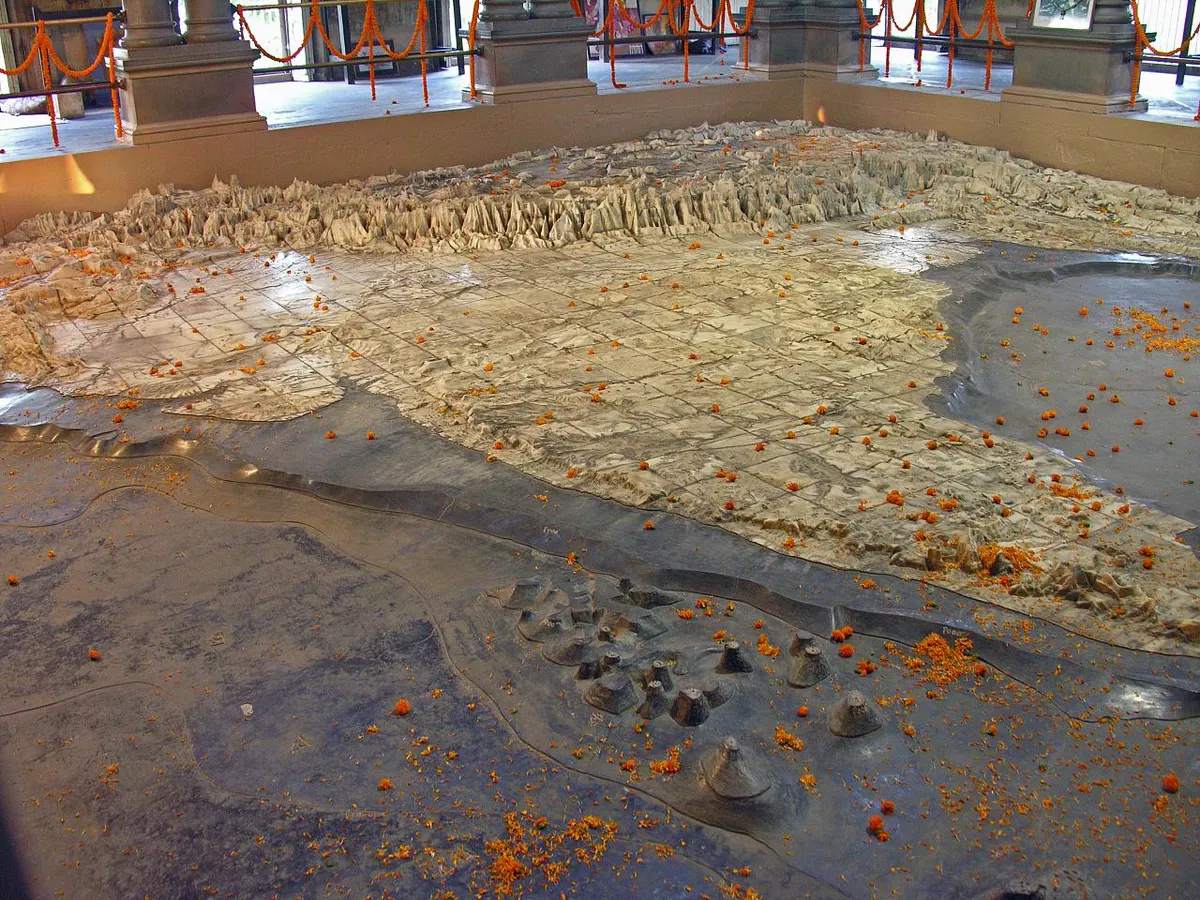
Bharat Mata Temple (Temple of Mother India) in Varanasi is unlike any other temple in India. Instead of a deity, the sanctum houses a marble relief map of undivided India — carved in extraordinary detail, with mountains, rivers, plains, and coastlines rendered in stone. The temple was inaugurated on 25 October 1936 by Mahatma Gandhi. It is not a place of religious worship in the conventional sense, but a national memorial — a secular shrine to the idea of India as a living, sacred motherland.
History: How the Temple Came to Be
The Bharat Mata Temple was founded by Babu Shiv Prasad Gupt, a nationalist and freedom fighter from Varanasi — also the founder of Kashi Vidyapith (a nationalist university established in 1921 as an alternative to British-controlled institutions). Shiv Prasad Gupt envisioned a temple dedicated not to a god but to the idea of India as the motherland — Bharat Mata.
The marble map inside the temple was carved with meticulous care — representing undivided India as it existed before Partition, with every mountain range, river system, and coastline rendered in relief. The result is more than three-dimensional geography: it is a devotional object, representing the land itself as sacred.
Mahatma Gandhi, who had a close association with Varanasi and with Kashi Vidyapith, inaugurated the temple on 25 October 1936. Gandhi is reported to have said at the inauguration that the temple was dedicated to all people, of all faiths — a temple where the deity was India itself and every Indian was a worshipper.
The Marble Map: What to See
The centrepiece of the temple is a large marble relief map on the ground floor. Surrounded by a walkway that allows viewing from all sides, the map depicts undivided India in relief — the Himalayas rising sharply in the north, the Deccan Plateau at middle elevation, the coastal plains at low relief, and the major rivers carved as channels running to the sea.
The scale and detail of the carving reward close inspection: individual mountain ranges are identifiable, major rivers are traceable from their Himalayan sources to the sea, and major cities and religious sites are marked. The map represents India as it was conceived before the 1947 Partition — a representation that carries its own historical and emotional resonance.
The upper floors of the temple building feature paintings and depictions of freedom fighters, saints, and national figures — making the building a combined patriotic and cultural monument.
Why Visit the Bharat Mata Temple
The Bharat Mata Temple is one of the most intellectually interesting sites in Varanasi — a city often visited for its religious intensity. Here, the concept of devotion is redirected from a god to a nation, from the transcendent to the geographic. The temple reflects a strand of Indian nationalist thought in which the land itself is sacred — the logic that underlies the concept of Bharat Mata (Mother India) in the independence movement.
For visitors interested in modern Indian history, the temple offers a direct connection to the independence era — both through the 1936 inauguration and through its association with Kashi Vidyapith, one of the institutions of the nationalist movement. Varanasi was a major centre of the independence struggle, and this temple is one of the most tangible monuments to that period.
Frequently Asked Questions
Is Bharat Mata Temple a Hindu temple?▼
Bharat Mata Temple is a national monument and cultural institution, not a conventional Hindu temple. It has no deity in the traditional religious sense — the central feature is a marble map of India. It was explicitly designed by its founder and inaugurated by Gandhi to be open to all people regardless of faith. Visitors of all nationalities and religions are welcome.
How long does a visit to Bharat Mata Temple take?▼
The temple is compact — a thorough visit including the ground-floor marble map and the upper floor paintings typically takes 30–45 minutes. It is often combined with a visit to the New Vishwanath Temple at BHU, which is in the same part of Varanasi.