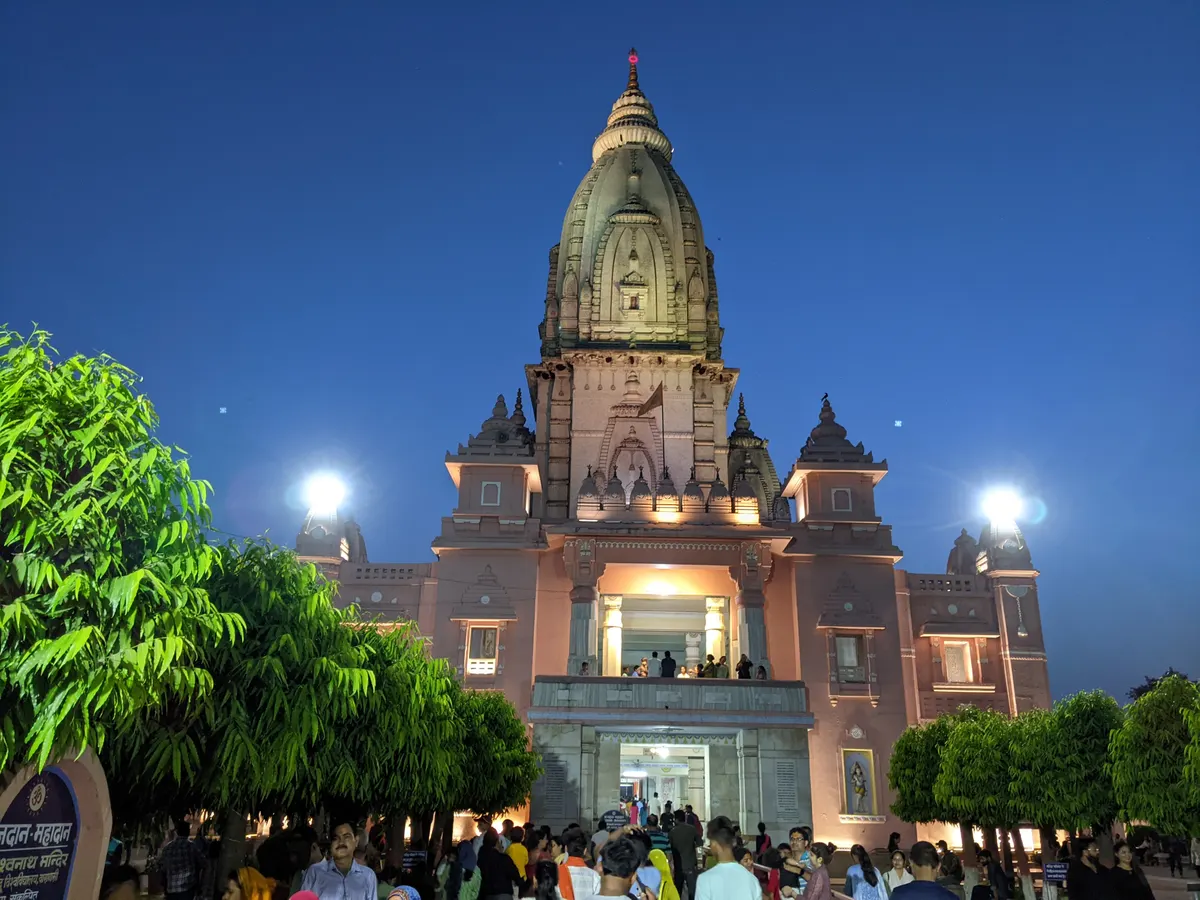
New Vishwanath Temple BHU Varanasi: The Birla Temple on Campus
Kashi Vishwanath in white marble — open to all, built by the Birla family, set in India's largest university
The New Vishwanath Temple at Banaras Hindu University (BHU) is one of the most architecturally striking temples in Varanasi — a soaring white marble structure built by the Birla family and modelled on the original Kashi Vishwanath Temple. Unlike the original Kashi Vishwanath, which has historically restricted entry to Hindus, the New Vishwanath Temple is explicitly open to people of all faiths. It rises above the BHU campus — the tallest structure on the university grounds — and stands as both a place of active Shaiva worship and a landmark visible from much of southern Varanasi.
History and Construction
The New Vishwanath Temple was built under the patronage of the Birla family — the same industrial house that funded Birla Mandir temples in Delhi, Jaipur, Hyderabad, Kolkata, and other cities across India. The temple at BHU was conceived in association with Pandit Madan Mohan Malaviya, the founder of Banaras Hindu University, who wanted a temple at the heart of the campus that could serve students and visitors of all backgrounds.
Construction was completed and the temple was consecrated in 1966. The architecture draws on the Nagara (north Indian) temple style — a tall shikhara (tower) rising over the sanctum — but executed in gleaming white Rajasthani marble rather than the red sandstone more commonly associated with north Indian temple architecture.
The choice to make the temple open to all faiths was deliberate: the Birla family's temple-building programme across India consistently emphasised accessibility and inclusivity, and the BHU campus context — one of India's great universities — reinforced this orientation.
The Temple and Its Features
The main sanctum houses a Shiva lingam — the same form of worship as the original Kashi Vishwanath. Surrounding shrines within the temple complex include images of Parvati, Lakshmi, Saraswati, Ganesha, and other deities. The temple interior is spacious by Varanasi standards — in contrast to the intimate and densely packed sanctums of the old city temples, the New Vishwanath Temple has broad halls and ample space for circumambulation.
The marble exterior and interior are carved with sculptural panels depicting deities, celestial beings, and scenes from Hindu scripture. The Nagara shikhara — the tall curved tower — is the defining visual element, oriented to the east.
The temple grounds and forecourt are well maintained, set within the leafy BHU campus. The contrast with the dense lanes of the old city temples is striking — this is a temple in an open, planned institutional setting.
Visiting BHU Campus
The New Vishwanath Temple is located within the campus of Banaras Hindu University — one of the most interesting institutions in Varanasi. BHU was founded in 1916 by Pandit Madan Mohan Malaviya and is one of the largest residential universities in Asia, with a campus covering 1,300 acres.
Within the campus, visitors can also see Bharat Kala Bhavan — one of India's finest collections of Indian art, sculpture, textiles, and manuscripts. Combining the temple visit with Bharat Kala Bhavan makes for a full half-day programme in the BHU area.
The campus is in the southern part of Varanasi, near Assi Ghat — making it a natural addition to a morning starting at the ghat. Auto-rickshaws and taxis operate from Godaulia and Assi Ghat to the BHU main gate.
Frequently Asked Questions
Is the New Vishwanath Temple different from the original Kashi Vishwanath?▼
Yes — they are separate temples. The original Kashi Vishwanath (Jyotirlinga) is in the old city near Dashashwamedh Ghat, within the Kashi Vishwanath Corridor. The New Vishwanath Temple at BHU is a 1966-built Birla temple modelled on the original, located on the BHU campus in south Varanasi. Both are active Shiva temples with lingam worship. The BHU temple is open to all faiths.
Can non-Hindus enter the New Vishwanath Temple?▼
Yes — the New Vishwanath Temple (BHU) was built with the explicit intention of welcoming visitors of all faiths. Non-Hindu visitors are welcome. Dress modestly (cover shoulders and knees), remove footwear at the entrance, and observe the general norms of respectful temple behaviour.